A Five-Sense Walk for a Setting
A five-sense walk for a setting helps you turn a familiar place into precise scene material, with a clear route from observation to character action.
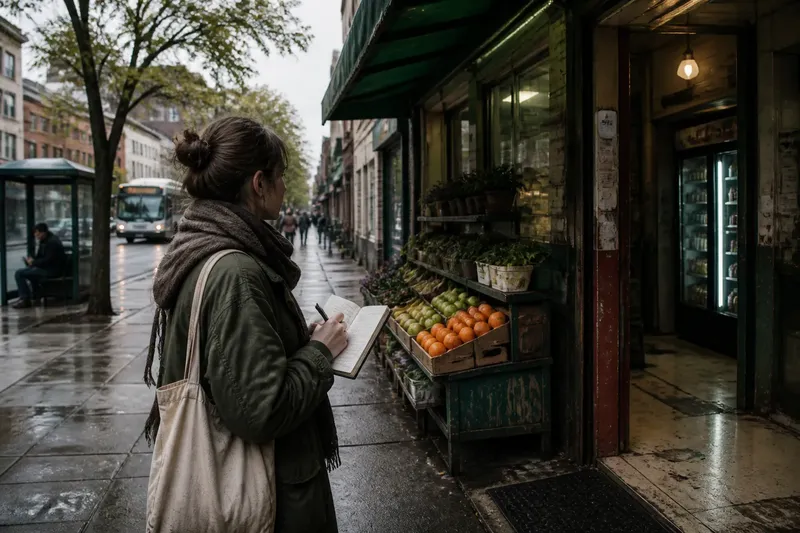
You cross a laundromat parking lot and hear a loose sign tap against its post; warm dryer air slips through the open door. A five-sense walk for a setting starts with particulars like these, then asks what they might make a character notice, avoid, or do.
Choose one place and keep returning
Pick a location you can visit comfortably without interrupting anyone: a bus shelter, corner store, public garden, or block around a library. Return to the same spot so you can distinguish what belongs to the place from what changes with weather, traffic, or your own attention.
Bring a pocket notebook or use a notes app, but put the device away while observing. Write a few words afterward. Avoid photographing strangers or recording conversations; the exercise concerns a place’s sensory texture, not other people’s private lives.
Choose a consistent route or vantage point, such as a bench, doorway, or spot beside a window. If the location is busy, stay in public areas and move on whenever your presence might make someone uncomfortable.
Give each day one sense and a clear task
Use the first five visits for the five senses, then use the last two to map and edit what you have gathered. This makes the structure explicit: sound, sight, touch, smell, and taste each get a turn, while space and selection have their own days. Keep every visit focused; you are not required to find a dramatic detail in every category.
- Monday, listen: Note a sound’s source, distance, and interruption. If a steady hum sits beneath occasional clanks, record what changes when a door closes; if you cannot locate a source, note that uncertainty rather than inventing one.
- Tuesday, look: Track edges, gaps, and surfaces. If a strip of faded paint is protected by a fixture, note the contrast; if nothing distinct stands out, mark a boundary or repeated shape instead of searching for a striking image.
- Wednesday, feel: Notice air on your skin, the ground underfoot, and the shift between sun and shade without touching anything unsafe or private. If an object is yours or clearly available to touch, note its texture; otherwise use the air, clothing, or ground as your source.
- Thursday, smell: Notice what arrives, fades, or is masked: damp leaves, soap near a doorway, warm dust, or food carried on the air. If a scent has a clear source, record it; if it drifts past without one, describe its arrival and disappearance rather than assigning a cause.
- Friday, taste: Taste only food or drink you brought or chose to eat. If a paper cup cools in a draft or a snack tastes smoky, note how the place affects the moment; if you have no food or drink, record that taste is unavailable on this visit and do not sample anything found there.
- Saturday, map space: Sketch the route between two points and mark bottlenecks, open areas, blind corners, and places to pause. If a path narrows, note who or what must yield; if it stays open, mark the sightline or easy route through it.
- Sunday, sort: Read the notes and circle details that recur, change, or suggest an action. If a detail can orient a character or affect movement, keep it for drafting; if it is vivid but has no scene use, save it separately.
Absence counts, too. A covered passage may offer little direct sunlight; a quiet garden may have no strong odor. If a distant engine becomes audible only when a fountain stops, the contrast gives you a relationship to note without forcing a sensation that is not there.
Connect each detail to a source, change, and route
“It smelled like coffee” is a label. “Coffee drifted from the corner shop, then vanished beneath the bus exhaust at the curb” gives the scent a source, a boundary, and a change. Those relationships make notes more distinctive than a list of sensory adjectives.
For each promising observation, jot down three things: what you noticed, where it seemed to come from, and what altered it. Then add a spatial cue: what blocks the view, how a sound carries, where the ground slopes, or which route remains open. A character can follow a sound, lose sight of someone behind a column, or hesitate at a narrow passage; the setting now affects action.
One useful variation is to track a single detail through the week. If the same doorway smells faintly of soap on one visit and carries street air on another, ask what changed in the scene’s conditions. That contrast can suggest a character’s shifting attention or a transition between moments, rather than merely supplying another item for description.
Turn the notes into a small scene choice
Imagine you visit a neighborhood market for several mornings and label your invented notes clearly as fiction: a low refrigerator buzz near the entrance, a tacky floor patch beside a cooler, and an aisle too narrow for two baskets to pass easily. You first mark the buzz as a sound the character can hear from the entrance; next, you place the tacky patch on the route to the aisle; then you use the pinch point to interrupt the character’s movement. The resulting scene has a character pause while the hum continues behind them, so the details orient the reader and create a small obstacle without claiming anything about a real market.
In your own draft, choose details that serve the immediate action. Someone waiting might register the door chime and the distance to a window; someone seeking an exit may notice a blocked sightline and the door’s position. The place stays the same, but a character’s purpose changes which details matter.
A sharp sound, a tactile cue, and one spatial relationship may be enough. It is not worth chasing every odor, testing every surface, or forcing an impressive metaphor; that effort can make a setting feel inspected rather than inhabited. Keep unused notes for another scene.
What questions help turn a walk into usable notes?
How long should a setting observation walk take?
Keep each visit brief enough to sustain attention, then return on separate days rather than trying to notice everything at once. If a visit begins to repeat the same observations, stop and return with a different sensory task.
What should I write down during the walk?
Capture a specific source, change, or spatial relationship instead of broad judgments such as “busy” or “peaceful.” If you cannot identify a source, describe what you actually noticed and leave the cause open.
Can I use a place I have never visited?
Direct sensory notes require a place you can observe, but you can combine those notes with invented details when building fiction. Keep the resulting setting fictional rather than presenting a blend of locations as a documented real place.
How do I keep sensory detail from crowding a scene?
Choose details that affect movement, attention, or the scene’s immediate mood. If a note does none of those jobs, leave it in the notebook instead of squeezing it into the draft.
Let the scene decide what stays
Before drafting, take a few notes from different senses and connect each to a character’s action or a point of orientation. A sound can draw a character toward a doorway; a rough edge can slow a hand; a clear gap can reveal who is approaching. Keep the rest close by, but let the scene’s needs—not the notebook’s length—decide what reaches the page.